1. Coming out of a long period of lethargy, depression, and illness that hit me hard as soon as I got home. I’ve heard from several friends that they’ve suffered similar bouts recently, so apparently the Other Side is making some moves. In any case, I’m feeling a good deal better, have been to Confession, read some edifying works, and am ready to start things moving again.
2. Said edifying works include Hilaire Belloc’s book on King James II, our last Catholic monarch, which is a typically fascinating and intimate portrayal. Belloc’s approach is to treat his subject as a man (imagine that!), to try to understand his personality, his character, and the common thread guiding him through life. In this case, he describes James as rather like a rod of steel: inflexible, direct, and focused, but focused to the point where he’s incapable of maneuver. He simply went straight for his goal every time. This is unlike, say, Richelieu, whose life was also dominated by a single fixed idea, but who was able to approach it by tacking back and forth as the situation changed. Simply put, he was utterly hopeless as a statesman or intriguer, and the politicians of his time ran circles around him. Belloc describes him as a born soldier, or better yet, a born sailor (there’s a splendid description of the Battle of Lowestoft, where three of James’s friends were blown apart by chain shot so close to him that a bit of skull lodged in his arm), but with no political sense whatever.
3. Most interesting, though, is the point on which James is so fixated; his Catholic faith. He’s received into the Church in middle life (about 1670), in the midst of a strongly anti-Catholic culture, with his brother sitting on a very precarious throne surrounded by the same kinds of men who murdered their father and are just itching for any chance to snatch the last remaining power from the crown. He’s head of the Admiralty, a job he dearly loves (Belloc credits him with creating the British navy as we know it). Soon after his conversion, Parliament passes the Test Act, explicitly excluding Catholics from public office by requiring anyone holding a position of public trust to deny Transubstantiation.
So what does he do? Not only does he convert under these circumstances, but he doesn’t even try to hide it. He resigns his post after the Test Act is put into effect. He refuses even to attend the Anglican services. He refuses to dissemble or compromise on the topic in any way, even when Parliament tries to block his succession (Charles’s deft handling saves that one, at least for the time being).
4. Subsequently, James becomes king (Charles is received into the Church on his deathbed, and there’s a touching scene where his final act is to ask for the curtains to be opened so that he can see the morning sun one last time. Again, Belloc excels at showing historical figures as human beings), puts down a rebellion by his illegitimate nephew, Monmouth (both brothers were notorious womanizers, and that didn’t change after his conversion: the general view of the time was that royalty was free in the matter of women. James deeply repented of this in his later years), deports Captain Blood to the colonies, and tries to push through religious toleration both for Catholics and ‘dissenters’ (Calvinists). His clumsy handling gives the politicians plenty of chances to portray him as a monstrous tyrant trying to impose Popery by force, and they set up with his son-in-law, Billy the Fruit, to come and replace him. Louis XIV sees what’s in the wind and tries to warn James, even offering to use his own forces to block the move, but James trusts Billy’s protestations of loyalty and doesn’t want to be seen as a puppet of France. Again, he had no political sense at all and was always shocked by men’s betrayals.
5. By the way, one of his chief traitors was John Churchill, Lord Marlborough, ancestor to Winston. Churchill was one of James’s chief commanders, and when Billy invaded, he was sent to stop them. He took leave of the King, lead the army out, then he and his officers (the enlisted almost all stayed loyal) went over and joined the Dutch. A lot of James’s allies went the same way; professing their loyalty up to the last minute, then simply walking over to the other side and leaving him to twist. This did not exclude his daughters, including Anne, who had been his darling and his favorite (I’ve heard that she, at least, showed an uneasy conscience over this later in life and it led her to be kinder to her Catholic subjects than some others).
Anyway, so James was deposed, and his subsequent efforts to regain the throne were thwarted first by the dearth of material in Ireland (they could raise a huge army of thirty or forty thousand men, but they only had about twenty-thousand muskets…of which only about one-in-ten was working), and then by bad weather and yet another betrayal when he tried to take a fleet from France to England. He spent the rest of his life in exile in France, where he turned to contemplation and prayer and became a very sincerely pious and penitent soul: “I abhor and detest myself for having so often offended so gracious and merciful a God,” he wrote (Belloc refers to his voluminous writings, and I would love to get my hands on them, but haven’t been able to find many online). His final command to his son was, “Keep the faith against all things and all men!”
6. As you can tell, I find the story of James II fascinating, all the more so because he was immediately made a stock villain of British history (again, see Captain Blood, or Nathaniel Hawthorne’s The Gray Champion) as a ‘tyrant’ and a ‘religious bigot’, when he was the one fighting for religious toleration and the one suffering from religious bigotry. That, and I have a great sympathy for men who are completely socially inept, yet find themselves at the crossroads of history. In any case, what a witness to faith! The man risked and finally lost three earthly crowns for himself and his line because he would not compromise on the Faith, dying in exile while professing his belief in Jesus Christ in the Eucharist. He’s definitely going on my personal litany of the Saints (his cause was opened in the 1700s, but never decided, so technically he’s a Servant of God).
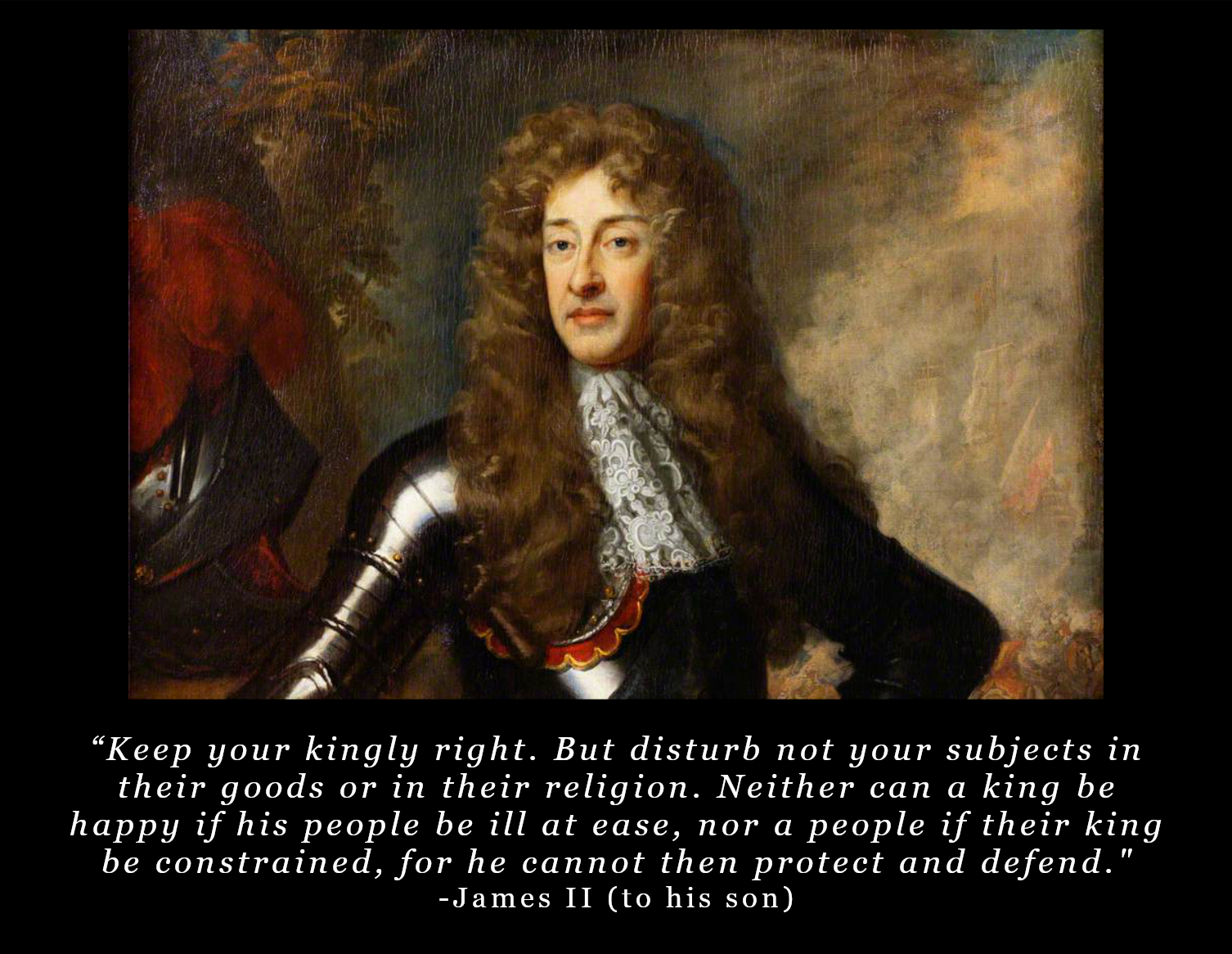
King James II, pray for us.
7. Let’s end with a darkly amusing anecdote to give you an idea of the state of things in Ireland. There was a unit of Irish dragoons – that is, men who were trained to ride to a position, dismount, and fight with their firearms – who were court-martialed for desertion. It was ruled that they should draw lots to select a man to be shot as punishment. They drew the lots, the unlucky man was selected, and only then was it discovered that none of their weapons would fire. This required their commander to borrow a working musket from another unit to carry out the sentence.
Oh, and Billy the Fruit’s career comes to an end when his horse trips over a molehill. This led to Jacobites toasting “The little gentleman in black velvet” who had relieved England of the Usurper.
 Serpent's Den
Very glad to read that you’re doing better. Hang in there.vv
Regarding James II, and especially paragraph 6, I can’t help noting that the modus operandi of anti-Catholic hate never changes: Demonize individuals, usually based on falsity or greatly exaggerated bits and pieces of truth, and accuse them of bigotry and all manner of evil, while the accusers practice the same vices as a matter of course. The more things change…
LikeLiked by 1 person