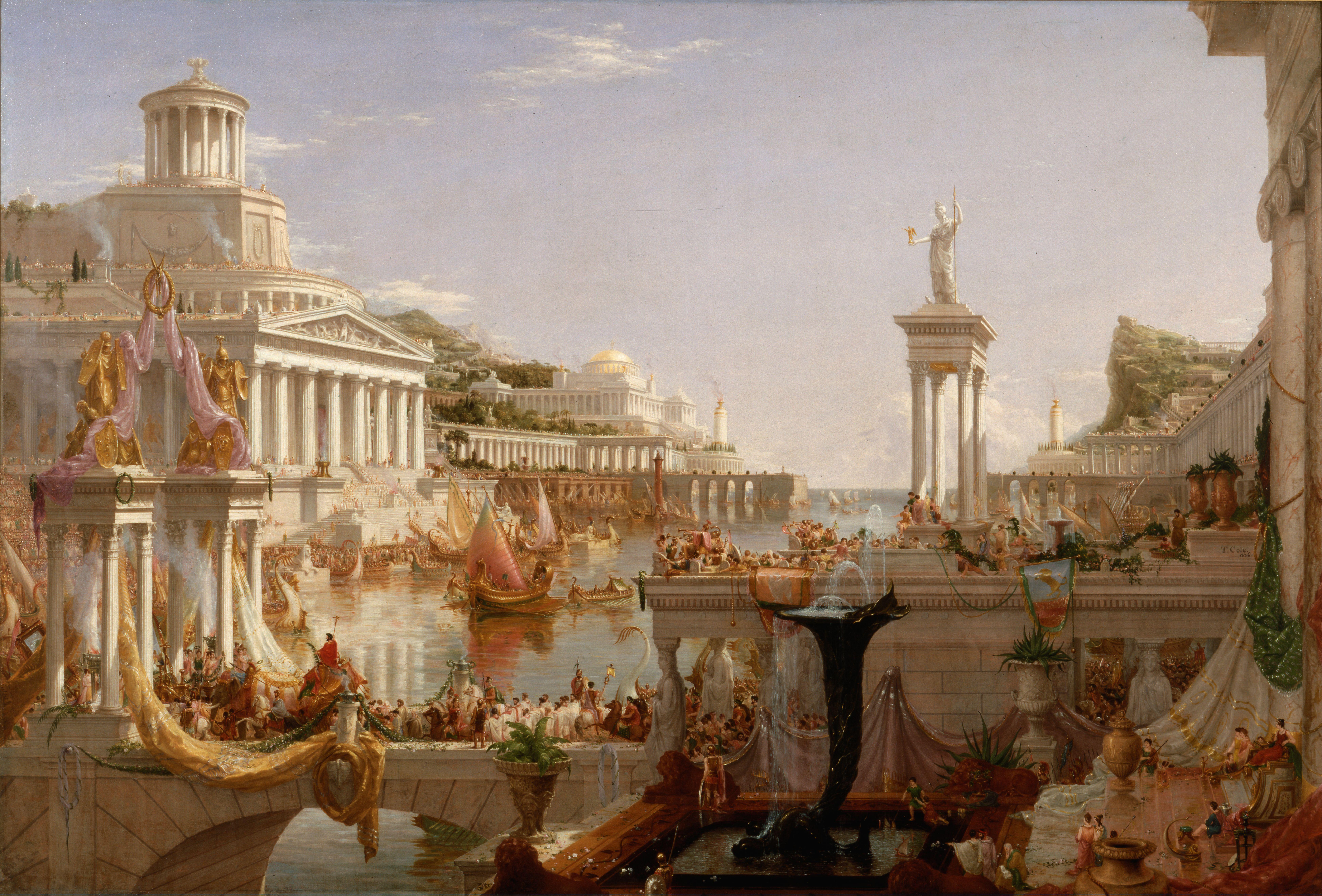
In 17 B.C., having brought peace and prosperity to the whole Roman Empire after centuries of non-stop war, revolution, and upheaval, having, indeed, brought peace to the Mediterranean world for the first time since man began to live there, Caesar Augustus decreed the holding of the Secular Games: six days of athletics, entertainment, and religious ceremonies at the end of May and the beginning of June, marking the end of one age and the beginning of another. The poet Horace was commissioned to write a lyric poem to be sung on the occasion:
O Phoebus, Diana queen of the woodlands,
Bright heavenly glories, both worshipped forever
And cherished forever, now grant what we pray for
At this sacred time,
When Sybilline verses have issued their warning
To innocent boys, and the virgins we’ve chosen,
To sing out their song to the gods, who have shown their
Love for the Seven Hills.
O kindly Sun, in your shining chariot, who
Herald the day, then hide it, to be born again
New yet the same, you will never know anything
Mightier than Rome!
O gentle Ilithyia, duly revealing
The child at full term, now protect gentle mothers,
Whether you’d rather be known as Lucina,
Or Genitalis.
Goddess, nurture our offspring, bring to fruition
The Senate’s decrees concerning the wedlock
Of women who’ll bear us more of our children,
The laws of marriage,
So the fixed cycle of years, ten times eleven,
Will bring back the singing again, bring back the games
We crowd to three times by daylight, as often,
By beautiful night.
And you, the Fates, who are truthful in prophecy
Link happy destinies, as has once been ordained
And let the certain course of events confirm it,
To those that are past.
Let Earth that is fruitful in crops, and in cattle,
Adorn our Ceres with garlands of wheat-ears:
And may Jupiter’s life-giving rain and breezes
Ripen the harvest.
Gentle and peaceful Apollo, lay down your arms,
And listen now to the young lads’ supplications:
Luna, crescent-horned queen of the constellations,
Give ear to the girls.
If Rome is your doing, and if from far Ilium
Came that band of people who reached the Tuscan shore,
Those commanded to change their home and their city,
On a lucky course,
Those for whom pious Aeneas, the survivor,
Who passed without injury through the flames of Troy,
Prepared a path to freedom, destined to grant him
Much more than he’d lost:
Then, you divinities, show our receptive youth
Virtue, grant peace and quiet to the old, and give
Children and wealth to the people of Romulus,
And every glory.
Whatever a noble descendant of Venus
And Anchises, asks, with a white steer’s sacrifice,
Let him obtain: a winner in war, merciful
To our fallen foe.
Now the Parthians fear our forces, powerful
On land, and on sea: they fear the Alban axes,
Now the once proud Indians, now the Scythians
Beg for an answer.
Now Faith and Peace, Honour, and ancient Modesty,
Dare to return once more, with neglected Virtue,
And blessed Plenty dares to appear again, now,
With her flowing horn.
May Phoebus, the augur, decked with the shining bow,
Phoebus who’s dear to the Nine Muses, that Phoebus
Who can offer relief to a weary body
With his healing art,
May he, if he favours the Palatine altars,
Extend Rome’s power, and Latium’s good-fortune,
Through the fresh ages, show, always, improvement,
Lustra ever new.
And may Diana, to whom is the Aventine,
And Mount Algidus, accept the entreaties
Of the Fifteen, and attend, and lend a fond ear,
To these children’s prayers.
We bear to our home the fine hope, and certain,
That such is Jupiter’s, and all the gods’ purpose:
We’re taught, we, the chorus, to sing praise of Phoebus,
Praise of Diana.
Flash-forward about 1900 years, to 1897. Queen Victoria, who nominally presides over an Empire that encompasses a quarter of the whole world, celebrates her sixtieth year on the throne of Britain, to which island civilization first came with the eagles of Rome. Victoria has presided over sixty years of near-unprecedented peace and prosperity for Britain, and indeed for Europe, sixty years which now seemed to promise a new age in which commerce, science, and technology would raise man to near godlike heights. Watching the staggering display of British naval power during the festivities, the poet Rudyard Kipling – in many ways the true, if unofficial, poet laureate of the British Empire – was moved to write a song of his own for the occasion, which appeared first in The Spectator and later found its way into the Anglican hymnal:
God of our fathers, known of old,
Lord of our far-flung battle-line,
Beneath whose awful Hand we hold
Dominion over palm and pine
Lord God of Hosts be with us yet,
Lest we forget – lest we forget!
The tumult and the shouting dies;
The Captains and the Kings depart:
Still stands Thine ancient sacrifice,
An humble and a contrite heart.
Lord God of Hosts, be with us yet,
Lest we forget – lest we forget!
Far-called, our navies melt away;
On dune and headland sinks the fire:
Lo, all our pomp of yesterday
Is one with Nineveh and Tyre!
Judge of the Nations, spare us yet,
Lest we forget – lest we forget!
If, drunk with sight of power, we loose
Wild tongues that have not Thee in awe,
Such boastings as the Gentiles use,
Or lesser breeds without the Law
Lord God of Hosts, be with us yet,
Lest we forget – lest we forget!
For heathen heart that puts her trust
In reeking tube and iron shard,
All valiant dust that builds on dust,
And guarding, calls not Thee to guard,
For frantic boast and foolish word
Thy mercy on Thy People, Lord!
Now a mere 64 years pass and we cross the Atlantic to America. The Europe of 1897 is a smoking ruin, but the once-colony is now itself an Empire in all-but name, whose legal rule extends across a whole continent and out into the ocean beyond, and whose influence and power of command extends, practically speaking, to over half the planet. Never has there been a nation of greater wealth or power upon the globe, one that, as of yet, can fairly claim to have never lost a war in all its history. Come to take up the command of this country is a young, handsome, charismatic man named John F. Kennedy, and at his inauguration the poet Robert Frost, one of the most renowned American poets of his day, issued the following lines:
The land was ours before we were the land’s
She was our land more than a hundred years
Before we were her people. She was ours
In Massachusetts, in Virginia,
But we were England’s, still colonials,
Possessing what we still were unpossessed by,
Possessed by what we now no more possessed.
Something we were withholding made us weak
Until we found out that it was ourselves
We were withholding from our land of living,
And forthwith found salvation in surrender.
Such as we were we gave ourselves outright
(The deed of gift was many deeds of war)
To the land vaguely realizing westward,
But still unstoried, artless, unenhanced,
Such as she was, such as she will become.
 Serpent's Den