By the rude bridge that arched the flood,
Their flag to April’s breeze unfurled,
Here once the embattled farmers stood
And fired the shot heard round the world
-Ralph Waldo Emerson
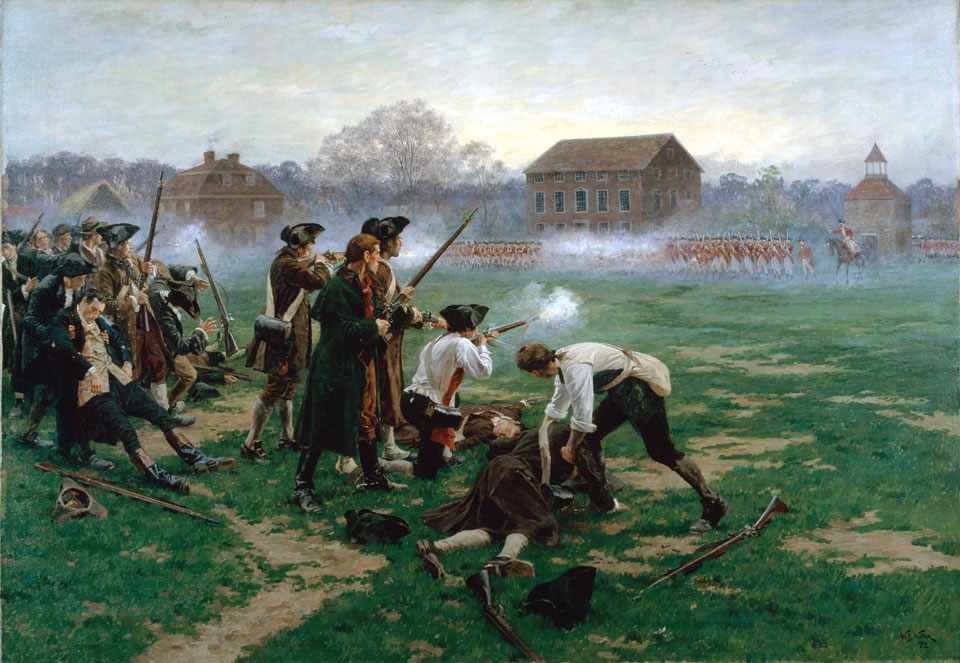
Exactly two hundred and fifty years ago today, British soldiers under Lt. Col. Francis Smith were sent by governor Thomas Gage to seize a stockpile of weapons which the rebelling colonists were thought to be holding in the village of Concord, and also to make the long-overdue arrest of Samuel Adams and John Hancock. The rebel intelligence network quickly discovered this and warned Adams and Hancock, removed most of the weapons, and raised the militia.
At the village of Lexington, the local militia turned out to confront the regulars. What happened next is unclear; eyewitness accounts all contradict each other. Some say the rebels shouted “we haven no king but Jesus!” (unlikely, given the lack of religious dimension to the conflict). Some say the rebels were dispersing until a shot was fired. Some say the shot came from the rebel side, some from the regulars, some from one of the homes. Some even say it was accidental. Regardless, a shot was fired and volleys were exchanged. The rebel force retreated with a handful of dead and wounded and the regulars moved on to Concord, where they found their birds flown. On the way back, they were ambushed and fired on from every barn, wall, and tree, leaving about a hundred dead and twice that wounded.
The incident confirmed what everyone pretty much knew; that the British government exercised authority in Boston alone, and beyond the bounds of the city Massachusetts Bay colony was in open revolt. The de-facto rebellion that had been in force since at least December 16, 1773 was now official, and the American Revolution was underway.
Of course, at the time few people around the world really cared about that shot. A bunch of half-savage British Puritan colonials were getting violent; must be a day ending in ‘y’. It would take another decade or two, or even longer (depending on how you choose to count it) before the echoes of that shot would ring in the halls of old Christendom.
For loyal British subjects, the shot signaled the start of eight years of intense frustration, betrayal, humiliation, and violence, and ultimately the loss of their homeland. For the rebels, it was the start of a long, bizarre struggle for independence that would end in triumph and the creation of something no one on the Lexington green could have predicted.
Two hundred and fifty years have come and gone from that shot. The ’embattled farmers’ triumphed more completely than they ever could have imagined; not only winning independence by winning the war of public opinion, despite there being absolutely no reason to think they would win either. The independent colonies became a single nation, then an empire in their own right, spreading their rule across the mostly-empty continent where they had been planted. The enormous wealth and power that this gave them allowed them to reach beyond their ocean moats and become the de-facto ruler of most of the world, including, in a supreme irony, their mother kingdom.
Those Massachusetts farmers wouldn’t recognize the country today, and they would undoubtedly find most of their heirs to be incomprehensible if not actually disgusting. Yet, for good or ill, the country we live in owes its present existence to that spark fired on this very day two and a half centuries ago. And for that, honour is due.
 Serpent's Den