1. My tastes have been skewed in a 1980s direction lately. This week’s movie night was Short Circuit (at least most of it; the copy I watched had a section missing that I couldn’t find elsewhere, between when the jerk boyfriend shows up and the fight with the other three drones), about a military robot that acquires sentience after being struck by lightning. It was fun. Not great cinema by any means, but cute, charming 80s comedy-fantasy. The anti-military theme is predictably lame, and the granola girl who can’t meet any nice guys is a character type that hasn’t aged well, but it’s got that zest and creative energy that so many films from this era had, going all out with the premise and really having fun with it all, and that carries it over a lot of potholes.
The main theme is really good too:
2. On the other hand, maybe it was in the part I missed, but the romance between the Breakfast Club girl and the Police Academy guy seemed to kind of come out of nowhere; they barely had any time together before they were suddenly smooching. The overall goofiness will be something your mileage may vary on, as is Fisher Stevens as a comedic Indian sidekick (me, I don’t really mind the cross-racial casting – and, impressively enough, apparently a lot of Indian viewers were convinced he was a particular Bollywood actor – though I thought his goofy malapropism shtick only landed some of the time).
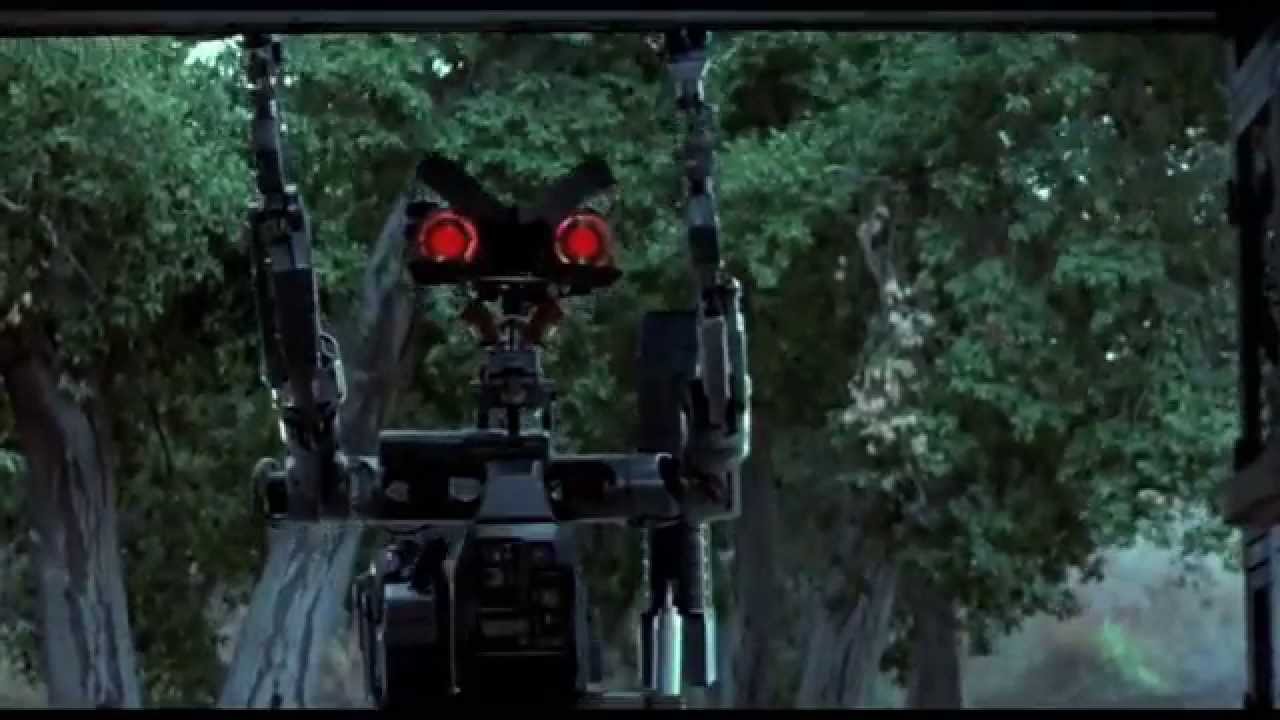
3. The main reason it works, though, is Number Five’s wide-eyed wonder and blank-slate innocence, brought to life via an excellent animatronic puppet. His antics and plight are engaging because he really seems like a genuine actor in the film, and his great design and voice work is like a gilding on everything, making it work twice as well as it would otherwise.
Kudos also for the fact that he takes a while to really form a personality; at first he’s just curious and has no context for anything. It’s only after he spends some time with a human and soaks up all the ‘input’ he can that he actually becomes a real character. The grasshopper scene might be the best one in the film as he puts together the concept of death and, with it, life.
His voice is done by Tim Blaney, Johnny Five’s main puppeteer. Apparently, the plan was for him to simply do the on-set voice and then they’d hire someone else to do the final version, but by the end of the shoot everyone was so used to his voice that they could no longer imagine anyone else as the character, and, yeah, I have to agree. Like I say, his pitch-perfect voice and delivery are a big reason the film works.
4. Johnny Five’s excellent design was a heavy influence on WALL-E, of course (binocular eyes, treads, folding body, etc.), though amusingly enough it’s also very reminiscent of one of the killer robots from the future scenes in The Terminator.
A small, dark part of me likes to imagine this is actually a prequel:
5. I fell abruptly ill this week with a cold / flu. It’s nowhere near as bad as ones I’ve had in the past, but it meant I had to take off school and send copious notes for the substitutes. The good news is that this caused me to hit on a new way of prepping for class that I think will help overall, so it’s a net benefit
6. The book we were using for my economics class (Whatever Happened to Penny Candy?) made my jaw drop when the author claimed that it was a ‘myth’ that oil prices cause the price of everything else to rise as well, saying that that only applies to plastics and other goods made primarily from oil. Apparently, he forgot the small matter of transportation costs (and even by his own logic: how many goods don’t come wrapped in plastic these days?).
Not a good sign in what is supposed to be a professional economist.
As noted last week, he also ascribes quite literally every negative economic outcome to inflation (well, except the ones he ascribes to higher taxes). That’s not really an exaggeration: that is his answer to practically everything. 2008 Financial Crisis? Inflation caused the housing bubble. Tulipmania? Caused by inflation by the Dutch government (even though, according to some cursory research, they were both on very hard currency and in the midst of policies aimed at reducing inflation at the time). The Dark Ages? Inflation caused by bad currency! That last one came paragraphs after he talked about the importance of knowing history, by the way.
This is all leading me to some suspicions, but it’d take too long to go into them.
7. Lent has begun! I’m aiming to focus on my lack of discipline and diligence this time around, with a stricter schedule and limits to internet / YouTube time.
There’s a fine line between self-improvement and penance, though ideally the latter should lead to the former. At least, that’s my goal for this Lent, since I really need it.
 Serpent's Den
:narrows eyes: Okay, just *when* was “Whatever Happened to Penny Candy?” published?
LikeLike
*looks up*
First edition 1978 (explains the obsession with inflation); current edition 2010.
LikeLiked by 1 person
1978 – the Carter malaise. That explains a lot. They probably didn’t update it for the reprint in 2010, either. Regina Caeli is the outfit you are working with, right? Or am I misremembering the name? They might have a supplement in the course explaining this is an error – and then again, they might not. It is catch as catch can for some homeschooling programs to grab books for subjects they wish to teach, and some stuff like this inevitably slips through, with the course having to make up for it elsewhere.
LikeLiked by 1 person
Yes, though I would expect any economist worth his fiat dollars to be able to distance himself from the political grievances of the moment when explaining the subject as a whole. Also, it’s been through about five or six editions since then; you would think that someone would have pointed out the problems to him and he’d have made corrections (though that leads into those suspicions I was talking about, which would need their own post).
In any case, that oil thing is inexcusable in my eyes because it’s such an incredibly basic point that he doesn’t even seem aware of: he talks about oil in terms of ‘energy production’, but not transportation.
Yes, I’m with Regina Caeli, and no, there’s nothing in the course materials correcting the errors (unless it’s addressed in the other economics books: we’ll see). I drew the students’ attention to it myself. Yeah…there seems a dearth of good homeschooling materials out there: there are only a few things we use that I actually feel reasonably satisfied with.
LikeLiked by 1 person
“Yes, though I would expect any economist worth his fiat dollars to be able to distance himself from the political grievances of the moment when explaining the subject as a whole.”
Not if he wanted to keep publishing and being respected, he wouldn’t. Particularly if he was a hundred percent behind both “we’ll run out of oil in X years” and/or “oil is killing the planet!” (Never mind that the planet *produces* oil, like any living thing, it’s Mankind’s Fault.) The publishers have been firm believers in both those ideas since the 1960s at the latest and for “the cause,” any lie – no matter how big – is worth the price. I am not at all surprised it got into the text book or that it hasn’t been corrected since ’78.
“…and no, there’s nothing in the course materials correcting the errors (unless it’s addressed in the other economics books: we’ll see).” Okay, now *that* is…interesting. How long has Regina Caeli been in operation? Were they founded relatively recently? They may not have had time yet to find all the bugs in the books and adjust the course material accordingly.
LikeLiked by 1 person
No, his point had nothing to do with peak oil or environmental matters; it was all him trying to deny that anything *but* the government could cause inflation through a rise in prices.
Say a barrel of oil costs X. Then something happens that makes it cost X+2 (production slows, an oil rig blows up, war breaks out, etc). Any industry that uses oil now has its operating cost go up – which is essentially all of them, except maybe software, since they all have to ship their goods and raw materials – which raises prices on those goods across the board to make up for it, reducing overall purchase power.
His argument (again, he doesn’t even address the transportation issue, which boggles my mind) is that, absent the government printing money, ‘oil-based goods’ will rise in prices, but other goods will fall in prices. Except, even if we accept that premise, one, those other goods represent a small fraction of the market (since almost everything has a transportation cost) and two, the affected share of the market will include almost all the *essential* goods, such as groceries or clothing, which really can’t be dispensed with. Food prices go up, so overall purchasing power must go down. You can buy less of it, but again, that’s a loss of purchasing power. And since this affects so many essential goods, it amounts to a decrease in actual purchasing power and a cross-the-board rise in prices.
RC’s been around for a while; they’re quite a large organization. I think they try out different material at different times, so that might be it.
LikeLiked by 1 person